The Fourth Movement: Rick Pitino, Zuby Ejiofor, and the Championship Rhythm Driving St. John’s Into March
Pitino’s Fourth Movement: Zuby, Championship Rhythm and the Tempo of March
By Jason Safford | Relentless Redstorm
The defense leaned left.
Rick Pitino saw the mistake before the pass even left the guard’s hands.
Across the sideline at Madison Square Garden he stood motionless, arms folded, watching the possession unfold the way a conductor listens for the first notes of a symphony he already knows by heart.
The ball swung to the wing.
Exactly where the play demanded.
Another pass traveled across the top of the key as the defense scrambled to recover, hands rising and feet sliding toward spaces that were already beginning to open.
Pitino had drawn this sequence hundreds of times on practice whiteboards.
Spacing.
Timing.
Patience.
Now the rhythm had arrived.
The ball reached Zuby Ejiofor at the top of the floor.
The possession had been written for this moment.
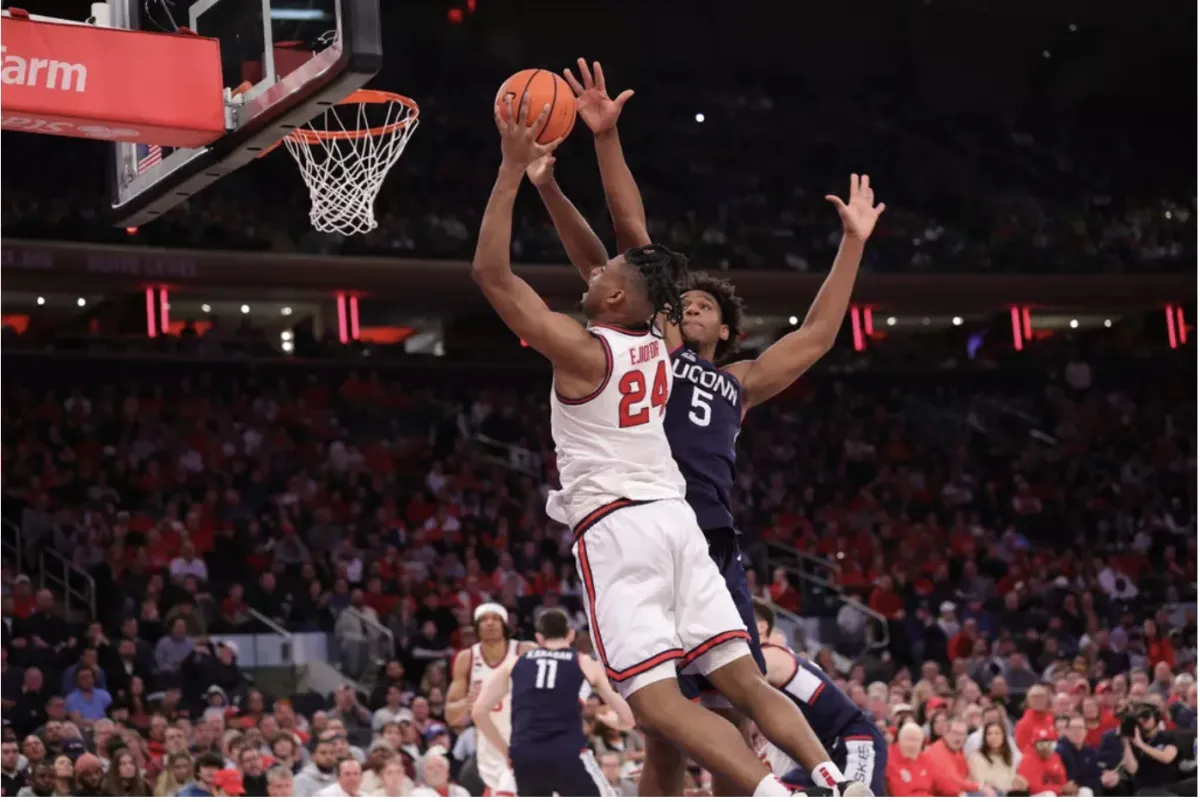
Ejiofor drove hard into the lane.
For half a heartbeat the defense hesitated.
Then two defenders lunged to close the gap.
Too late.
Ejiofor rose through contact and kissed the ball softly off the glass.
The whistle cut through the roar.
The ball dropped clean through the net.
Madison Square Garden exploded.
Ejiofor landed beneath the rim, chest rising, scoreboard glowing above him.
Two points.
And one more waiting at the line.
Pitino did not celebrate.
He simply listened to the floor.
Because the possession had unfolded exactly the way he imagined.
Pass.
Spacing.
Attack.
Pressure until the defense cracked.
For two seasons Pitino had been building that rhythm inside the bones of the program.
Now the music was playing itself.
The Symphony Pitino Conducted
This season did not unfold like a schedule.
It unfolded like a symphony.
Four movements.
Each building toward the next.
Each tightening the rhythm.
Each demanding more precision from the players learning Pitino’s music.
The fourth movement has now arrived.
But the story begins earlier.
Movement I — Installing the Tempo
Championship teams rarely stay together anymore, not in an era shaped by NIL money and the constant churn of the transfer portal, where rosters can change almost overnight and the confetti from one season’s celebration barely settles before the next rebuild begins.
The confetti from last season’s title had hardly cleared the floor when the St. John’s roster started shifting again, as seniors graduated, others entered the portal, and the orchestra Rick Pitino had conducted through a championship season slowly dissolved piece by piece.
Pitino did not complain about the new landscape or the instability surrounding it.
He simply began assembling another orchestra.
Portal players arrived from across the country, each carrying different habits, different systems, and different interpretations of the game learned under other coaches in other gyms.
Talent was not difficult to find.
Understanding Pitino’s rhythm was something else entirely.
Because Pitino does not coach comfort.
He coaches pressure in every form the game allows: full-court pressure that stretches opponents across forty feet of hardwood, half-court pressure that suffocates spacing, and the constant mental pressure that forces players to think faster than they ever have before.
Practices moved at a pace that surprised newcomers, every drill accelerating beyond expectation, every mistake stopping the gym cold until clarity returned to the possession.
Pitino was not merely installing plays or teaching spacing.
He was installing resilience.
And at the center of nearly every drill stood Zuby Ejiofor, the lone returning foundation of the program and the one player who already understood the music Pitino wanted the team to play.
Rebound everything.
Protect the paint.
Attack each possession like survival depends on it.
The new arrivals watched carefully at first, listening more than speaking as they struggled to match the tempo of the system surrounding them.
Gradually the adjustment began.
Ball movement sharpened.
Defensive rotations tightened.
Voices grew louder across the floor as communication replaced hesitation.
Slowly the orchestra began learning the score.
Because Pitino understands something about modern college basketball that many coaches still resist accepting.
Rosters change every year.
Systems must not.
Movement II — Pressure Reveals the Truth
Every symphony carries tension, and in the architecture of a long basketball season that tension often reveals itself in the second movement, when the rhythm established in early preparation must withstand the unforgiving pressure of real competition.
The first movement installs the tempo and teaches the orchestra how the music should sound.
The second movement asks a harder question.
Can the orchestra survive playing it under stress?
Early in the season, the sound of St. John’s basketball felt uneven at times, not because the talent was lacking, but because the tempo of Rick Pitino’s demanding system had not yet settled into a unified rhythm.
New players were learning the structure.
They moved fast.
But they did not always move together.
Possessions drifted when timing slipped.
Rotations arrived a step too late.
Rebounds escaped hands that had not yet absorbed the urgency required in Pitino’s game.
The Big East rarely waits for chemistry to form.
It exposes its absence.
Opponents attacked the small gaps in St. John’s structure, turning possessions into tight battles and games into laboratories where the truth of the roster slowly revealed itself.
Rick Pitino watched carefully, the way he always does when a new team begins learning his system.
Great conductors listen closely for the moment when the orchestra drifts slightly out of sync.
Then they adjust the tempo.
Pitino saw the adjustment clearly.
The team needed more force.
More speed.
More violence on the glass.
The answer arrived in the form of Dillon Mitchell.
When Pitino inserted Mitchell into the starting lineup, the sound of the team changed almost immediately.
Mitchell did not enter the rotation quietly.
He arrived like percussion.
Explosive on the glass.
Relentless in transition.
Defensive length stretching across the floor.
Where the rhythm once hesitated, Mitchell accelerated it.
Loose balls became fast breaks.
Missed shots turned into second chances.
Defensive pressure began extending further up the court.
Suddenly the orchestra carried more power behind every note.
The shift altered the chemistry of the team.
Mitchell’s energy amplified everything around him.
Defensive rotations tightened.
Rebounding regained its violence.
Spacing improved because the pace demanded precision.
And at the center of it all remained Zuby Ejiofor.
The anchor of the system.
The stabilizing force beneath the chaos.
If Mitchell had become the percussion driving the rhythm forward, Ejiofor remained the bass line holding the entire structure together.
Together they changed the sound of the team.
Pressure intensified.
Tempo accelerated.
Confidence followed.
This is the stage where many seasons fracture under the weight of rising expectations, sharpening criticism, and the constant noise that surrounds competitive programs.
But Pitino’s teams are not designed to survive comfort.
They are built to survive pressure.
Because pressure eventually reveals the truth of every roster.
Some teams fracture under it.
Some teams fade.
The St. John’s orchestra began to harden instead.
Players stopped reacting to pressure.
They started creating it.
And once that shift occurred, the rhythm of the season began moving toward something far more dangerous.
Momentum.
The orchestra was no longer learning the music.
It was beginning to play it.
And Madison Square Garden was starting to hear the sound again.
Movement III — When the Orchestra Began to Play
The first movement assembled the orchestra, teaching new players the rhythm and structure of Rick Pitino’s demanding system.
The second movement hardened that orchestra under pressure, forcing the team to survive early turbulence until the tempo finally began holding together.
The third movement changed the sound entirely.
That change began on defense.
At first it appeared quietly in the small disruptions that alter a possession before the arena fully understands what happened.
A deflection near midcourt.
A guard sliding his feet faster than expected.
Hands flashing into passing lanes.
The ball suddenly moving the wrong direction.
Then the sound grew unmistakable.
Church bells.
Not the gentle bells of a quiet town.
The loud, urgent bells that ring across a city.
Because when Dylan Darling began pressing the ball, something inside the rhythm of the game shifted.
Darling did not simply defend possessions.
He hunted them.
Full-court pressure stretched offenses across forty feet.
Half-court pressure closed space.
Sideline traps and passing-lane ambushes turned routine dribbles into danger.
Opposing guards began to feel the floor shrinking beneath them.
The tempo Pitino had installed all season was no longer theoretical.
Darling made it unavoidable.
His hands stayed quick.
His feet stayed relentless.
His eyes searched constantly for the smallest mistake.
When the ball came loose, the orchestra erupted.
Fast breaks ignited.
Madison Square Garden rose.
Momentum flipped in seconds.
If Dillon Mitchell had become the percussion driving the rhythm with explosive rebounding and transition energy, Darling became the church bells announcing that rhythm across the arena.
Every steal rang like a warning.
Pressure was coming.
And it would not stop.
Behind that defensive surge, the structure Pitino built tightened perfectly.
Rotations sharpened.
Rebounding grew ferocious.
The offense accelerated because the defense demanded it.
At the center of it all remained Zuby Ejiofor.
The anchor in the paint.
Darling attacked the perimeter.
Mitchell controlled the glass.
Ejiofor ruled the interior.
Three sounds.
One orchestra.
By the time the third movement reached full volume, the team’s identity had become unmistakable.
This was no longer a roster learning Pitino’s system.
It was a program living inside it.
The pressure now belonged to St. John’s.
Opponents felt it the moment they crossed half court.
Madison Square Garden felt it with every defensive stop.
The bells kept ringing.
And the rhythm of the season accelerated toward its final movement.
Because once the orchestra discovered this sound, the championship tempo was no longer a possibility.
It was becoming inevitable.
Movement IV — Championship Rhythm
By the time the season reached its final stretch, St. John’s had stopped reacting to games and had begun quietly conducting them, shaping each night’s rhythm the way an orchestra controls the pace of a long symphony.
Opponents arrived with different identities and intentions, some pushing the game into a sprint and others grinding it into half-court battles, yet Pitino’s team repeatedly bent those styles toward its own tempo.
Fast teams discovered St. John’s could run longer than expected.
Physical teams discovered a rebounding ferocity that turned every miss into another possession.
Patient teams discovered something even more unsettling: the defense never stopped pressing and never allowed the game to settle into anyone else’s control.
Here the architecture of Pitino’s system revealed itself.
Basketball rarely unfolds cleanly.
Momentum surges.
Crowds rise.
Whistles shift the tone.
A ten-point lead can vanish in two hurried possessions before players recognize what changed.
Teams driven only by emotion panic in those moments.
Pitino’s teams respond differently.
They slow the possession, reset spacing, find the next pass, and trust the structure they have rehearsed hundreds of times in practice.
When opponents surged late in the season, the answer rarely came through desperation.
It arrived through discipline.
A defensive stop.
A rebound ripped through traffic by Zuby Ejiofor.
A loose ball chased down by Dillon Mitchell.
A steal from Dylan Darling igniting a fast break and flipping the energy of the floor.
Possession by possession, the rhythm returned.
That rhythm separates good teams from championship teams.
Good teams chase momentum.
Championship teams control it.
By the final weeks of the season, Madison Square Garden began recognizing the sound again.
Calm inside chaos.
Precision inside noise.
The orchestra Pitino had assembled possession by possession was no longer learning the music.
It was conducting the performance itself.
The result became unmistakable.
St. John’s stood atop the Big East once again.
Back-to-back champions.
The No. 1 seed entering the conference tournament.
Most important, a team whose rhythm never fractured even as March pressure tightened around every possession.
Because the fourth movement of a championship season does not end with a banner.
It ends with mastery.
A team that understands tempo.
A team that absorbs pressure without losing clarity.
A team that adjusts to every whistle, every run, every surge of emotion.
Most dangerous of all, a team that plays through chaos without losing rhythm.
Rick Pitino’s orchestra had reached that point.
And the loudest note of the symphony had not yet been played.
The First Violin
Every orchestra carries a lead instrument, the voice that steadies the music when the tempo quickens and the room fills with energy.
For St. John’s this season, that instrument has been Zuby Ejiofor.
His year has moved into rare territory.
Big East Player of the Year.
Big East Defensive Player of the Year.
Unanimous First Team.
Few players command both ends of the floor with that authority. Yet the box score only hints at his impact. Ejiofor’s value lives inside the possessions that statistics struggle to measure.
The rebound ripped through three bodies.
The rotation that erases a driving lane before it forms.
The calm outlet pass that steadies the floor before panic spreads.
He anchors the rhythm. He protects the paint. And when the moment demands force, he meets it head on.
Just like the play Pitino had already seen unfolding.
The Conductor
Great orchestras require more than talented musicians. They require a conductor who hears the entire score at once and knows when every note must rise.
Rick Pitino controls the rhythm of everything inside the program.
The pace of practice.
Spacing of the offense.
Violence of the defense.
Clarity of every decision made under pressure.
Players inside his system do not improvise.
They execute.
Execution survives pressure.
That truth has defined Pitino’s career for decades, from Providence to Kentucky, from Louisville to Queens. Uniforms change. Arenas change. The discipline does not.
Because when discipline is installed deeply enough, it becomes culture.
New York Hears the Music Again
Madison Square Garden remembers greatness.
The echoes of old St. John’s teams still linger in the rafters, reminders of a program that once shook the city.
For years the sound faded.
Now it returns.
Students roar. Alumni lean forward again. The city responds the way New York always does when toughness shows itself on a hardwood floor.
This team carries that toughness every night.
The rhythm feels familiar to the city. Yet the structure beneath it belongs to a modern era filled with noise.
Endless commentary.
Floods of statistics.
Distractions swirling around every successful program.
Pitino answers the same way he always has.
Structure.
Discipline.
Tempo.
Because discipline quiets distraction. And structure keeps the rhythm alive.
The Furnace of March
Now the music grows louder.
The Big East Tournament begins.
Four nights. Four battles.
Madison Square Garden becomes a furnace where every possession carries weight and every mistake echoes through the building.
Every opponent believes the top seed can fall.
But Pitino built the season for this moment.
Practices built for pressure.
Rotations built for fatigue.
Defense built for survival.
The orchestra does not fear chaos.
It performs inside it.
The Next Stage
Beyond the Garden waits the national stage.
The NCAA Tournament.
The entire country watching.
The entire country asking the same question.
Is St. John’s truly back?
The answer will not come from headlines.
It will come from possessions.
From rebounds.
From defensive stops.
From moments that turn pressure into clarity.
Pass.
Spacing.
Attack.
Pressure cracks the lane.
A captain rises through contact.
Two points through chaos.
One more free throw waiting.
The Final Note
Madison Square Garden rises again.
Zuby Ejiofor stands at the free-throw line as the arena leans toward him and the roar climbs toward the rafters.
Rick Pitino waits near the sideline, arms folded, eyes steady.
The conductor listens.
Because beneath the noise he hears the rhythm holding.
The fourth movement has begun.
And somewhere beyond the Garden, the final note of the symphony is still rising.
#StJohnsBasketball #RelentlessRedStorm #RickPitino #BigEastBasketball #MarchMadness #CollegeBasketball #ZubyEjiofor #MadisonSquareGarden #BasketballCulture #ChampionshipMindset #NYCBasketball #PressureDefense #BasketballLeadership #BigEastTournament