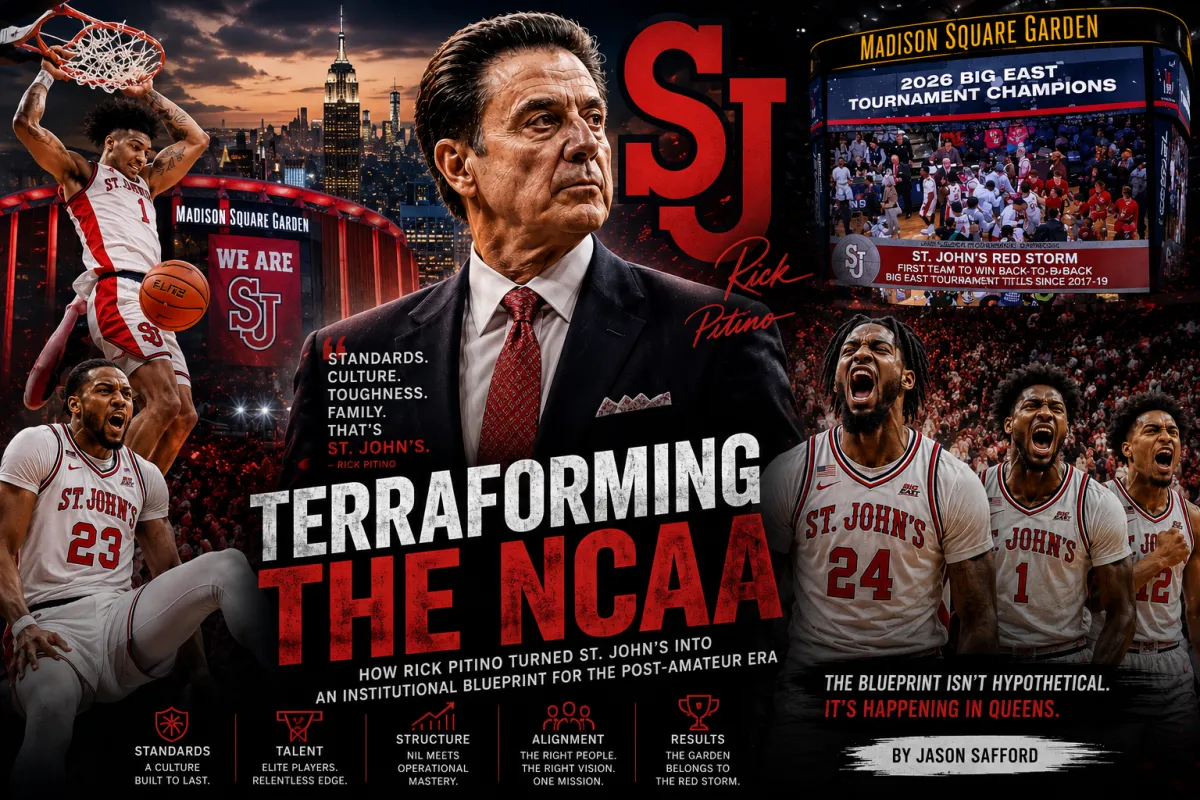
Terraforming the NCAA: How Rick Pitino Turned St. John’s Into an Institutional Blueprint for the Post-Amateur Era
Terraforming the NCAA: How Rick Pitino Turned St. John’s Into an Institutional Blueprint for the Post-Amateur Era
By Jason Safford | Relentless Redstorm
The Second Act
The Garden was not quiet that day.
It never is when New York senses the possibility of resurrection.
The old building carries memory differently than most arenas. Banners hang there like family ghosts. The ceiling remembers dynasties. The floor remembers collapses. Every few years, the city convinces itself another sleeping giant is about to wake.
Most of the time, it is wishful thinking.
This time felt different.
Rick Pitino walked into Madison Square Garden beneath the television lights with the St. John’s logo behind him and the pressure of a wounded institution sitting invisibly on his shoulders. He was in his seventies now. The hair grayer. The voice rougher. The career already immortal.
But he did not sound like a man arriving for nostalgia.
He sounded like a builder studying a damaged structure.
“St. John’s is one of the legendary names in college basketball,” he said. “Now we’re ready to fall on great times. Raise this roof up, because St. John’s is going to be back, I guarantee that.”
The line detonated through the room.
New York loves certainty because New York almost never offers it.
But beneath the theater sat something more consequential than confidence.
Pitino was describing an institutional rebuild.
Not a season.
Not a recruiting class.
Not a publicity cycle.
A redesign.
Because by the time Pitino arrived in Queens, college basketball had already crossed into a new economic age.
The old model, where tradition insulated institutions from collapse, had broken apart in public.
NIL accelerated everything.
Athletes moved like capital.
Donors behaved like venture investors.
Universities competed like firms under pressure.
Programs built on sentiment began to fracture.
The strongest institutions no longer win simply because they possess history.
They win because they can metabolize chaos faster than their competitors.
That was the real challenge confronting St. John’s.
Not whether it could win games.
Whether it could survive modernization.
Pitino brought the standards.
Mike Repole brought conviction-backed capital.
Ed Kull brought operational infrastructure.
But beneath all three sat something even more important:
The pursuit of something harder to build.
An institution capable of absorbing volatility without losing shape.
That is why the St. John’s story matters far beyond basketball.
Because beneath the roar of Madison Square Garden sits a larger question facing every legacy institution in America:
When the world changes faster than your identity, what keeps the structure from collapsing?
That is the real story unfolding at St. John’s.
And it may become one of the defining case studies of the post-amateur era.
Organizational Resilience: The Institutional Skeleton
By 2026, the defining question in college athletics had moved beyond NIL itself.
The challenge was existential.
How does a legacy institution survive the professionalization of everything?
That question placed St. John’s at the center of a larger American story.
Not because the program was winning games.
Because the university had become a visible experiment in adaptation under pressure.
The story was no longer primarily about paying players.
It was about whether a legacy institution could absorb volatility without surrendering identity.
Inside that transformation sat a three-part leadership structure increasingly common inside elite enterprises.
Pitino established standards.
Repole supplied conviction-backed capital.
Kull operated with the urgency of a growth-stage founder.
Together, they formed a modern leadership triad built for instability.
The most sophisticated aspect of the St. John’s transformation may be invisible to casual observers.
Behind the headlines and Madison Square Garden energy sat a deeper operating principle.
The structure had to hold under pressure.
NIL introduced constant volatility into college athletics.
Roster movement accelerated.
Revenue pressures intensified.
The market became transparent.
Most institutions responded emotionally.
St. John’s responded structurally.
The collective, donor alignment, player development pipeline, and cultural standards increasingly operated as interconnected supports inside the program’s broader structure.
The objective was not simply survival.
It became durability.
The Real Story Was Never NIL
The easiest way to misunderstand the St. John’s resurgence is to frame it as a basketball comeback.
A more accurate interpretation is that St. John’s offers one of the clearest early examples of how a legacy institution can adapt to the collapse of the amateur model.
For decades, the NCAA functioned under the illusion that collegiate athletics and professional sports occupied separate economic universes.
NIL accelerated the erosion of that separation.
The moment athletes gained market leverage, the industry transformed almost overnight:
Recruiting became talent acquisition.
Locker rooms became portfolio ecosystems.
Coaches became operator-executives.
Athletic departments became revenue engines.
Donors became strategic capital allocators.
The terrain itself changed.
College sports had entered a different economic landscape.
And in newly terraformed environments, legacy institutions face the same existential question every disrupted company eventually confronts:
Can the organization evolve faster than the market around it?
Most conversations about NIL collapse into shallow arguments about whether paying athletes is “good” or “bad.” That misses the larger reality.
NIL did not change college sports because money entered the system.
Money was always there.
What changed was visibility.
The market became transparent.
Once athletes gained mobility and leverage, every weakness inside athletic departments became exposed simultaneously:
Weak leadership.
Misaligned incentives.
Slow decision-making.
Donor fragmentation.
Poor revenue architecture.
Culture without accountability.
Programs that once survived on tradition suddenly had to operate like high-performance enterprises.
The strongest programs increasingly aligned standards, talent evaluation, capital, operations, and institutional identity.
Every major St. John’s acquisition increasingly reflects this principle.
Zuby Ejiofor was not simply retained.
He was strategically aligned.
Donnie Freeman is not merely a recruit.
He represents future-state coherence between elite NBA-level upside and the developmental rigor of the Pitino system.
The acquisitions fit the institution itself.
Most were unprepared.
St. John’s was different because its leadership recognized a brutal truth earlier than many of its competitors:
The future would belong to institutions capable of unifying culture, capital, talent evaluation, and operational discipline faster than everyone else.
That is what made Pitino the perfect hire.
Not because he represented the past.
Because he understood the future.
Pitino’s Greatest Reinvention
The most important evolution in Rick Pitino’s career was not tactical.
It was philosophical.
For decades, Pitino was viewed as a basketball savant driven by pressure defense, intensity, and force.
At St. John’s, he revealed something different.
A systems thinker.
“One of the keys of coaching,” Pitino explained, “it’s not only strategy or motivation. It is really getting players that fit your system. It’s about evaluating the right players.”
That statement explains much of modern college basketball.
The schools winning consistently are not necessarily the ones spending the most money.
They are the ones allocating talent with the highest precision.
Pitino understood that immediately.
This was not recruiting.
It was filtration.
Every acquisition passed through a standard built around fit, discipline, intensity, and durability.
The objective was not maximizing talent.
It was reducing entropy.
That philosophy shaped the roster.
Dillon Mitchell arrived as a validated asset. Bryce Hopkins represented competitive market capture. Zuby Ejiofor became proof the system could internally compound player value.
Pitino understood something many institutions still resist.
Money can buy talent.
Money cannot buy accountability.
Why St. John’s Became the Perfect Laboratory
The timing was almost cinematic.
St. John’s sat in the center of the country’s largest media market carrying one of college basketball’s most recognizable dormant brands.
The symbolism was powerful:
New York City.
Madison Square Garden.
A sleeping Catholic-basketball giant.
But symbols alone do not rebuild institutions.
Operating systems do.
Pitino understood that St. John’s possessed something increasingly rare in modern sports:
Untapped emotional equity.
He repeatedly framed the rebuild not simply as winning games but restoring identity.
He spoke about Father Brian Shanley building “something special” through academics and facilities while he would build “something special in between the lines and in the community with all the St. John’s fans.”
That division of labor was revealing.
The university would build the platform.
Pitino would build the emotional engine.
The distinction mirrors what elite corporate turnarounds often require:
Infrastructure alone does not create momentum.
Institutions recover when operational competence and cultural belief begin reinforcing each other.
At St. John’s, those forces converged simultaneously.
Mike Repole and the Arrival of Strategic Capital
If Pitino represented standards, Mike Repole represented belief made liquid.
Calling Repole a donor understates his role.
He behaved more like strategic capital.
Historically, university booster culture operated emotionally. A bad season triggered panic. Funding became reactive. Institutions drifted.
Repole approached St. John’s differently.
He spoke like a long-term investor.
“We want to build a dynasty over here for the next five to 10 years.”
Dynasty is not donor language.
It is investor language.
It implies scale, permanence, and compounding value.
That became the Repole Effect.
Capital no longer existed simply to sustain operations.
It became a mechanism for increasing institutional gravity.
That gravity attracted talent, sponsors, visibility, and belief.
Repole appeared to make the same calculation elite investors often make about extraordinary operators.
Back the system builder early.
Not simply because Pitino could win games.
Because he could create alignment.
And alignment compounds faster than money alone.
Ed Kull and the Professionalization of the Machine
If Pitino supplied standards and Repole supplied capital, Ed Kull built the operating infrastructure.
His task extended beyond administration.
He had to professionalize the machine.
Revenue generation became central to the athletic department’s survival.
Sponsorships, donor coordination, ticket demand, media visibility, and brand partnerships became interconnected parts of the same system.
That system extended beyond the university.
As St. John’s regained relevance, the effects moved outward through New York.
Restaurants filled.
Sponsors returned.
Media attention accelerated.
Madison Square Garden regained energy.
The basketball program increasingly behaved like an economic anchor.
That may become one of the most overlooked truths in modern sports.
Elite athletic brands now function as regional infrastructure.
The Player Became a Portfolio Asset
The NIL era transformed roster construction into capital allocation.
Players became strategic acquisitions.
Every acquisition signaled seriousness, stability, and developmental credibility.
That is why the St. John’s roster increasingly resembled an investment portfolio.
Each player served a different strategic purpose.
Dillon Mitchell represented a validated asset.
Bryce Hopkins represented competitive reallocation inside the Big East.
Zuby Ejiofor became the clearest proof that the system could multiply value internally.
His rise into a 2026 AP All-American and Big East Player of the Year transformed him into institutional evidence.
Not hype.
Evidence.
That distinction matters.
Most institutions still optimize for acquisition.
Elite programs protect fit.
The portal no longer functioned as a threat to St. John’s.
It functioned as a supply chain.
Future-Proofing the Enterprise
The most sophisticated organizations are not merely built for present success.
They are designed to perpetuate future relevance.
This is where the next generation of St. John’s talent acquisition becomes strategically important.
Donnie Freeman represents more than an elite recruit.
He represents a signal to the national market.
When St. John’s enters the orbit of top-tier NBA-level high school talent, the university is effectively competing against:
Blue-blood collegiate powers.
G-League developmental systems.
Alternative professional pathways.
International developmental ecosystems.
This is the Freeman Future.
The Freeman Future describes the moment a revitalized institution begins consistently winning bidding wars for the top 1% of basketball talent.
At that point, recruitment itself becomes terraformed.
The market no longer views St. John’s as a nostalgic legacy brand.
It views Queens as a premium pre-professional ecosystem.
And once perception changes, talent pipelines accelerate.
The same logic applies to the next acquisition wave, Ellis, Brown, Sane, and future developmental classes.
Because elite talent follows visible proof of concept.
Which brings the story full circle.
The exits matter as much as the arrivals.
Daniss Jenkins. Kadary Richmond. And the graduating 2025-26 contributors moving toward NBA and G-League opportunities.
Their transitions into professional basketball create something every institution desperately seeks:
External validation.
Once former players succeed professionally, they cease being alumni.
They become brand ambassadors.
Walking proof that the operating system works.
That creates a compounding cycle:
Development produces visibility.
Visibility attracts elite recruits.
Elite recruits elevate the brand.
Brand elevation attracts more capital.
More capital strengthens development.
This is no longer recruiting.
It is ecosystem engineering.
Roster Construction as Portfolio Management
In 2026, Rick Pitino does not merely build a basketball team.
He manages a portfolio.
Zuby Ejiofor is the blue-chip stock held for long-term appreciation.
Dillon Mitchell is the high-yield acquisition designed for immediate returns.
Bryce Hopkins represents strategic market capture from direct competitors.
Donnie Freeman is the venture-scale speculative asset with transformational upside.
Daniss Jenkins, Kadary Richmond and the outgoing professional pipeline become externalized proof-of-concept assets, brand ambassadors validating the enterprise itself.
This is not traditional coaching.
It is wealth management applied to organizational performance.
And that may be the clearest explanation yet for why St. John’s suddenly feels less like a college basketball program and more like a fully integrated competitive enterprise.
Succession Architecture and the Hidden Genius of Pitino’s Final Act
Most great turnarounds fail for one reason:
They remain personality dependent.
The leader leaves.
Momentum disappears.
The institution reverts.
What makes St. John’s especially fascinating is the possibility that Pitino’s final years are not merely about winning games.
They are about institutional transfer.
His renegotiated contract should not be viewed simply as compensation.
It should be viewed as succession architecture.
Because the final challenge of every transformational leader is identical:
Can the institution preserve the operating philosophy after the founder exits daily control?
This is where most turnarounds collapse.
The charisma disappears.
Standards erode.
Culture fragments.
Momentum reverses.
St. John’s appears to be attempting something more sophisticated.
Instead of treating Pitino’s later years as a countdown clock, the university can use them as a transfer window, embedding his standards into the institution itself.
That changes the meaning of the contract entirely.
The agreement becomes:
Competitive insurance.
Succession planning.
Donor stabilization.
Brand continuity.
Institutional memory preservation.
Ambassadorial transition infrastructure.
In corporate terms, this resembles founder transition planning inside elite companies.
The organization seeks to preserve the founder’s operating DNA even after direct operational control eventually changes hands.
It is succession architecture.
A bridge between turnaround and permanence.
The university appears to understand something many organizations discover too late:
Elite leadership is most valuable when its philosophy becomes embedded into the institution itself.
If Pitino eventually transitions into an ambassadorial role, preserving donor confidence, alumni trust, recruiting gravity, and symbolic authority, then St. John’s may achieve something far more durable than a temporary comeback.
It may create continuity.
And continuity is where dynasties actually begin.
The Mathematics of Flow
The St. John’s transformation reveals something larger about modern institutions.
Success no longer comes from emotion alone.
Emotion ignites movements.
Structure sustains them.
That distinction now defines the future of college athletics.
The NCAA increasingly resembles a regulated professional industry operating under permanent instability.
Federal scrutiny continues to rise.
Compliance pressure intensifies.
The transfer portal never fully stops moving.
Some programs still behave as though volatility is temporary.
They panic after roster losses.
Spend impulsively.
Confuse noise for momentum.
Everything becomes reactive.
St. John’s chose a different path.
The university treated instability as permanent and built accordingly.
The collective aligned with the institution.
Player development aligned with retention.
Donor capital aligned with long-term infrastructure.
Recruiting aligned with identity.
Each layer reinforced the next.
That is why the program increasingly behaves less like a traditional college team and more like an institution built to hold.
Not perfect.
Not finished.
But stable under pressure.
That may become the defining competitive advantage of the NIL era.
Because the institutions dominating the future will not simply spend more aggressively.
They will move with greater alignment while the rest of the industry reacts emotionally around them.
And alignment compounds.
The Systems That Survive
The deeper significance of St. John’s has almost nothing to do with basketball.
It is a case study in adaptation under pressure.
Markets shift.
Talent gains leverage.
Legacy systems lose relevance.
Most organizations respond tactically.
St. John’s responded systemically.
Pitino established standards.
Repole supplied belief-backed capital.
Kull professionalized the infrastructure.
Each force amplified the others.
That may become the defining lesson of the NIL era.
The institutions that survive are not necessarily the richest.
They are the most aligned.
The Structure Remembers Itself
The easiest way to misunderstand St. John’s is to reduce the story to money.
Money matters. Every modern institution needs capital.
Still, capital without structure burns quickly.
Pressure reveals whether a system can hold.
That may be the clearest lesson inside the St. John’s rebuild.
The university did not simply hire a famous coach.
It redesigned itself for a new era.
Pitino established standards.
Repole stabilized belief with conviction-backed capital.
Kull built operational durability.
Together, they created institutional alignment.
Modern sports increasingly rewards institutions capable of staying aligned under pressure.
Programs can no longer survive on tradition alone.
Athletes move freely.
Markets shift rapidly.
Attention changes overnight.
The institutions that survive will be the ones built to absorb pressure without losing shape.
Not motivation.
Not branding.
Structure.
The St. John’s model now operates like a fully integrated enterprise.
Talent acquisition connects to development.
Development connects to visibility.
Visibility connects to revenue.
Revenue connects to infrastructure.
Infrastructure reinforces culture.
Each layer strengthens the next.
That is why the story reaches far beyond basketball.
Every legacy institution now faces the same challenge.
Can leadership, capital, operations, standards, and identity move in the same direction before disruption arrives?
Most organizations fail at that task.
St. John’s is attempting to solve it in public.
The future will not belong only to the institutions with the most history.
Nor to the institutions with the most money.
It will belong to the institutions that can align faster than the world changes.
That is the real blueprint emerging in Queens.
Not a comeback story.
An operating system for institutional survival.
Late at night after the Garden empties, the building reveals the truth quietly.
Workers sweep popcorn from concrete steps.
Security guards lean against railings high above the floor.
The overhead lights dim slowly across thousands of empty seats.
Then the silence arrives.
Not dead silence.
Resting silence.
The kind large institutions carry between transformations.
For years, that silence felt haunted inside St. John’s basketball.
Now it feels loaded.
Like pressure gathering beneath steel.
Like belief learning how to breathe again.
That emotional shift may be the most important signal of all.
Because institutions rarely collapse all at once.
They erode slowly.
Standards weaken.
Confidence disappears.
Alignment fractures.
People stop believing the future belongs to them.
Then something subtle happens.
The structure remembers itself.
That is what New York is responding to now.
Not simply wins.
Recognition.
The rise is no longer theoretical.
St. John’s now carries back-to-back Big East championships and a return to the NCAA Tournament’s second weekend.
Madison Square Garden feels alive again in March.
The banners no longer belong only to memory.
They belong to the present tense.
Recognition that St. John’s no longer behaves like a nostalgic brand trapped inside old memories.
It behaves like a living institution rediscovering force.
Inside the locker room, players speak about standards.
Within donor circles, conversations revolve around sustainability.
Around athletic offices, the language has shifted from survival to scale.
Even the emotional texture of the program feels different.
Urgency replaced resignation.
Expectation replaced anxiety.
Movement replaced drift.
Something steadier had replaced the drift.
People could feel it before they could explain it.
That is why the story resonates beyond sports.
Every institution in America now lives under some version of the same pressure:
Can the organization absorb instability without surrendering identity?
Can leadership create alignment before fragmentation becomes irreversible?
Can systems hold under volatility?
Most cannot.
St. John’s is attempting to prove otherwise.
That may become Rick Pitino’s greatest victory.
Not merely restoring relevance.
Installing permanence.
And deep inside the noise of Madison Square Garden, the rest of college basketball can already hear the structure moving.
Not collapsing.
Becoming.
#StJohns #RickPitino #RedStorm #CollegeBasketball #BigEast #NIL #MadisonSquareGarden #SportsBusiness #Leadership #BasketballCulture #QueensNY #NCAA #SportsWriting #SportsMedia #TransferPortal #ZubyEjiofor #DillonMitchell #DonnieFreeman #OrganizationalResilience #SystemsThinking #BusinessLeadership #CultureMatters #OperationalExcellence #InstitutionalLeadership #ResilienceArchitecture